
What if the very narrative you've built around your suffering is the only thing standing between you and a restored life? When you're caught in the middle of a major life change, it's easy to feel stuck in a loop of isolation where the words for your grief simply won't come. You aren't just looking for a way to forget; you're looking for a way to make sense of the wreckage. Real healing from emotional pain through stories happens when we stop seeing our trials as the end of the book and start viewing them as the foundation for a new, more resilient chapter.
You likely already believe that a poignant book or a song can shift your mood, but there's a deeper methodology to using these creative outlets for lasting restoration. This article provides a blueprint for rebuilding your life after the storm by using purposeful storytelling, music, and creative expression to find your footing. We'll explore how to externalize your pain through narrative, discover tools to help your children heal alongside you, and find a sense of grounded hope that feels authentic. From modern reflection tools to the raw power of a well-crafted melody, you'll learn how to turn your most difficult seasons into a creative sanctuary for growth.
Key Takeaways
- Understand why deep grief often bypasses logical language and how creative narratives provide the words you have been unable to find.
- Learn the science of narrative externalization, a technique that allows you to process heavy emotions safely by viewing them through a character’s journey.
- Discover how healing from emotional pain through stories, especially through the simplicity of children’s narratives, can offer a blueprint for adult restoration.
- Establish a methodical daily routine using the "Story First" technique to anchor your morning in resilience and grounded hope.
- Explore how creative tools like faith-based music and purposeful fiction from Storm & Me Official can help you rebuild your life after a difficult season.
The Architecture of Unspoken Hurt: Why Traditional Words Often Fail
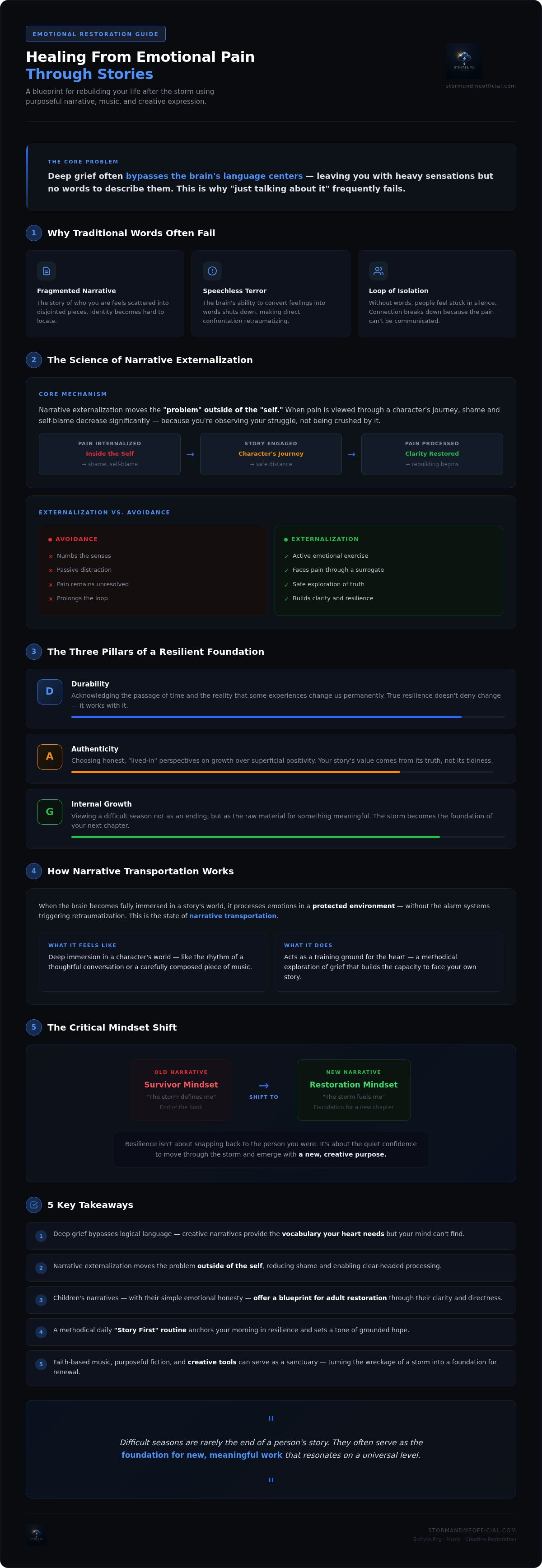
Emotional pain is not a lack of strength; it is a disruption of your internal architecture. The silent storm of deep grief or major life change often bypasses the logical language centers of the brain, leaving you with heavy sensations but no clear vocabulary to describe them. When you're in the thick of a difficult season, your internal narrative can become fragmented. It's hard to see a path forward when the story of who you are feels like it's been scattered into disjointed pieces. Healing from emotional pain through stories provides a way to reassemble those fragments into a structure that finally makes sense.
There are clear limitations to "just talking" when your heart is in a state of total upheaval. If you can't find the words, you can't talk your way out of the hurt. This is why many people feel stuck in a loop of isolation. You need more than a conversation; you need a creative sanctuary. This is a safe space where pain can be explored through imagination and craftsmanship rather than direct, clinical confrontation. It's about finding a "lived-in" wisdom that acknowledges the weight of your experience without demanding an immediate explanation.
When the Heart Loses Its Vocabulary
Psychologists often describe a phenomenon called speechless terror, where the brain's ability to turn feelings into words simply shuts down. In these moments, direct confrontation with your pain can lead to further retraumatization. Stories act as a vital bridge between abstract feeling and concrete understanding. By engaging with a narrative, you begin the process of healing from emotional pain through stories at a safe distance. You can see your own struggle reflected in a character's journey, which allows your mind to process heavy emotions without feeling personally under fire.
The Role of Resilience in Rebuilding
Resilience isn't about snapping back to the person you were before the trouble started. It's about the quiet confidence to move through the storm and emerge with a new, creative purpose. This grounded hope is built by shifting from a survivor mindset to one of restoration. Consider these elements of a resilient foundation:
- Durability: Acknowledging the passage of time and the reality that some experiences change us permanently.
- Authenticity: Eschewing superficial positivity in favor of an honest, "lived-in" perspective on growth.
- Internal Growth: Viewing a difficult season not as an ending, but as the raw material for something meaningful.
Difficult seasons are rarely the end of a person's story. Instead, they often serve as the foundation for new, meaningful work that resonates on a universal level. By finding your footing in a creative sanctuary, you can begin to turn the wreckage of a storm into a blueprint for a restored life.
The Science of Narrative Externalization: How Stories Facilitate Healing
Narrative externalization is the process of viewing one’s pain through a character’s journey. This psychological shift is a cornerstone of recovery because it moves the "problem" outside of the "self." When you are in the middle of a storm, it's common to internalize the chaos as a personal failure. Externalization breaks this cycle by allowing you to observe your struggle from a distance, which significantly reduces the burden of shame and self-blame. By placing your emotional weight onto a fictional or shared narrative, you gain the stability and clarity required to rebuild your life after a period of upheaval.
The power of "narrative transportation" is more than just a literary concept. It is a state where the brain processes emotions safely by becoming fully immersed in a story's world. This immersion acts as a training ground for the heart. Healing from emotional pain through stories works because it provides a protected environment where you can confront difficult truths without your brain's alarm systems going off. It allows for a methodical exploration of grief, much like the rhythm of a thoughtful conversation or a carefully composed piece of music.
Externalization vs. Avoidance
It’s a mistake to think that reading or listening to stories is a form of passive distraction. In reality, engaging with a purposeful narrative is an active emotional exercise. While avoidance seeks to numb the senses, externalization encourages you to face the pain through a surrogate. This creates the "witness effect," where seeing a character survive validates your own internal struggle. You aren't running away from your feelings; you're creating a safe distance between your raw emotion and your logical mind. This gap is where real growth begins to take root.
The Brain on Story: Neural Coupling and Empathy
The biological response to storytelling involves complex neural activity that fosters resilience. Mirror neurons play a key role, as they allow your brain to experience a character’s resilience as if it were your own. This phenomenon, known as neural coupling, synchronizes your brain waves with the narrative's flow, often triggering the release of oxytocin. This hormone promotes a profound sense of connection and safety, which is essential when you feel emotionally isolated. Exploring these creative tools for restoration helps you rewrite your internal script from "I am broken" to "I am in a season of rebuilding." It transforms your pain from a dead end into the raw material for a new, authentic purpose.
From Fables to Melodies: Choosing the Right Narrative for Your Season
Every season of restoration has its own unique cadence. The creative input you need during the initial shock of a "storm" is vastly different from what you require months later as you begin to rebuild. Healing from emotional pain through stories is a dynamic process that adapts to your current capacity for reflection. Sometimes the heart is too weary for a dense textbook or a complex psychological study. In those moments, the soul craves simplicity, rhythm, and a steady, declarative anchor to hold onto while the winds are still high.
The Power of Children’s Stories for Adults
There is a profound reason why simple metaphors, such as a storm or a lost compass, resonate so deeply when we are hurting. Children’s emotional-healing stories strip away the academic jargon that often clutters adult recovery. They speak directly to foundational wounds, allowing you to reconnect with your "inner child" in a way that feels safe and non-threatening. Using these stories as a starting point also creates a natural bridge for family-wide healing conversations. It allows parents and children to share a common language for grief, ensuring that no one has to navigate the wreckage alone.
Music as a Lyrical Narrative
Music provides a different kind of narrative, one that bypasses the logical mind to speak directly to the spirit. The impact of rhythm and melody on emotional regulation is significant, acting as a tool for spiritual renewal when words feel too heavy to carry. Faith-based lyrics offer a steady anchor, providing a sense of durability and authenticity during hard times. Willy Will’s approach to recording focuses on this specific intersection. By crafting music designed for deep reflection and inner strength, he provides a lyrical sanctuary where listeners can find their footing and rediscover their quiet confidence.
Faith-Centered Personal Development
Integrating spiritual truths into the creative process turns the act of healing into a form of craftsmanship. This is where internal growth meets tangible expression. By viewing your difficult season as a foundation for new work, you transition from merely surviving to finding a creative purpose. This intersection of faith and imagination suggests that your story is not over; it is simply being refined. Finding meaning in the raw material of your pain is a powerful act of restoration. It allows you to move forward with a sense of grounded hope, knowing that every project and every word is a step toward a meaningful, authentic life.
Practical Ways to Integrate Healing Stories Into Your Daily Routine
Restoration is not a passive state; it is a practice you build with intention and quiet confidence. Establishing a methodical rhythm for emotional processing allows you to find your footing when the world feels unstable. Healing from emotional pain through stories becomes most effective when it's woven into the fabric of your everyday life. By creating small, intentional windows for reflection, you turn the raw material of your struggle into a foundation for new, meaningful work. This process doesn't require hours of effort, but it does require a commitment to authenticity and the patience to let your story unfold at its own speed.
The "Story First" technique is a powerful way to anchor your day in resilience. Instead of reaching for a screen or a to-do list the moment you wake up, reach for a narrative that reflects the grounded hope you wish to cultivate. This simple shift ensures that your first internal script of the day is one of rebuilding rather than one of survival. It provides a steady, declarative anchor that stays with you, even when the demands of life begin to pull at your attention.
Creating a Daily Creative Sanctuary
Transforming your environment into a creative sanctuary starts with three simple, methodical steps. First, dedicate 15 minutes to a story or a song that mirrors your current season. Second, identify one "anchor sentence" from that narrative to carry with you throughout the day. Finally, journal a single paragraph from the perspective of a character who overcame a storm. This practice of narrative externalization helps you view your challenges with a sense of durability and perspective, making the abstract process of growth feel concrete and achievable.
Healing the Family Through Shared Narrative
One of the most significant gaps in traditional recovery is the lack of focus on the family unit. Children’s emotional-healing stories are not just for kids; they're tools for the entire household to navigate big emotions together. By reading these stories aloud, you create a safe space for post-story discussion without the pressure of forced clinical questions. Music also plays a vital role here. Playing faith-based melodies in the home sets a calming atmosphere, allowing every member of the family to process their journey in a supportive, reassuring environment.
The Role of Tangible Comfort
Healing is an internal process, but physical items can serve as tactile anchors. Resilience-themed apparel and merchandise act as tangible reminders of your quiet strength. When you wear your journey, you're making a sincere statement about your commitment to growth and authenticity. Choosing gifts for someone grieving that offer this sense of tactile comfort can be far more impactful than words alone. If you're ready to start your own practice, explore our official merchandise and creative tools to find your own tangible anchors of resilience. Every piece of craftsmanship is designed to support you as you move through the storm and into a season of restoration.
Finding Your Path Forward: The Storm & Me Approach to Restoration
Storm & Me Official operates as a creative sanctuary for those who've navigated deep waters and are looking for a way back to themselves. It's a hub where the physical act of creation meets the internal work of recovery. While many platforms offer generic advice, this space is built on "lived-in" wisdom. This means every book, song, and garment is rooted in real experiences of survival and restoration. Healing from emotional pain through stories is not a trend here; it's a commitment to the idea that our most difficult seasons are often the raw material for our most meaningful work.
Integrating the works of author Will Scott and recording artist Willy Will provides a holistic journey for the spirit. You aren't just reading a book or listening to a track. You're engaging with a methodical process of finding your footing. This approach moves you from being a passive consumer of other people's narratives to finding your own creative footing. It encourages a shift from the isolation of grief toward the quiet confidence of a life being rebuilt. By providing tangible tools for emotional restoration, we help you bridge the gap between abstract pain and a concrete future.
A Sanctuary for the Soul
The path to restoration is often found in the simplest places. Exploring children’s stories that deal with grief and big emotions allows for a softening of the heart that complex psychology sometimes misses. When paired with faith-based music, these narratives provide a dual-layered approach to mental health and spiritual growth. Willy Will’s music acts as a lyrical anchor, while Will Scott’s stories offer a narrative blueprint. Supporting this journey through meaningful, resilience-themed apparel adds a tactile dimension to your recovery, serving as a daily reminder that you're durable and authentic.
Your Story Is Not Over
It's vital to reframe your current storm not as a tragic ending, but as the foundation for a new, meaningful chapter. Finding a creative mentor who's emerged from their own trials with purpose can make all the difference in your perspective. A mentor doesn't lecture; they guide you toward your own internal strength. Your pain is not a wasted season. It's the soil where new growth is beginning to take root. As you move forward, we invite you to explore the Storm & Me Official collection to find your next anchor. Whether it's a story that speaks to your child's heart or a song that steadies your own, these tools are here to support your journey toward restoration.
Rebuilding Your Life After the Storm
The journey toward restoration is rarely a straight line, but it's one you don't have to walk alone. By understanding the architecture of your hurt and utilizing narrative externalization, you've learned that your pain can be moved from the center of your identity to the pages of a shared journey. You now have the tools to establish a "Story First" rhythm, ensuring that your mornings are anchored in grounded hope rather than survival. Whether you're simplifying complex grief through children’s metaphors or finding spiritual renewal in faith-based melodies, healing from emotional pain through stories is a tangible path to a restored life.
Storm & Me Official exists to be your creative sanctuary during these difficult seasons. From Author Will Scott’s stories for emotional healing to the resilience-centered music of Willy Will, every piece we craft is designed to help you find your footing. Our resilience-themed apparel also provides tactile anchors to remind you of your durability throughout the day. We invite you to Explore the Storm & Me Sanctuary for Healing Stories and Music to discover the specific tools you need for your current season. Your current struggle is not the final chapter; it's the foundation for a new, meaningful work that reflects your quiet strength and authenticity.
Frequently Asked Questions
How can reading stories help with emotional pain?
Stories offer a way to view your struggles through a character's journey, which reduces personal shame and isolation. This process moves the heavy weight of a "storm" from your internal identity to an external narrative. By engaging with a character's resilience, your brain processes complex emotions in a safe, imaginative space. This method of healing from emotional pain through stories provides the stability and clarity needed to begin rebuilding your life after a major upheaval.
What are the best types of stories for healing from grief?
The best stories for restoration are those that offer a "lived-in" wisdom rather than superficial fixes. Children’s emotional-healing stories are particularly effective because they use simple metaphors to address foundational wounds. Fiction that provides practical encouragement also serves as a blueprint for finding your footing. These narratives should focus on themes of durability and authenticity, supporting the belief that a difficult season is not the end, but a foundation for new work and personal growth.
Can children’s books really help adults process trauma?
Children’s books often resonate more deeply with adults because they strip away technical jargon and speak to the "inner child." Metaphors like a "silent storm" or a lost compass provide a clear vocabulary for grief that traditional language often fails to capture. These stories facilitate healing from emotional pain through stories by simplifying complex trauma into manageable, universal truths. They create a creative sanctuary where foundational healing can begin without the pressure of forced clinical explanations.
How does music contribute to emotional restoration?
Music bypasses the logical mind to speak directly to the spirit, providing a lyrical sanctuary for reflection. Faith-based melodies, like those released by Willy Will, act as steady, declarative anchors during times of upheaval. The rhythm and melody help regulate emotions, while the lyrics provide a sense of connection and spiritual renewal. This combination fosters inner strength and quiet confidence, allowing you to process your journey at a methodical and reassuring pace that feels deeply personal.
What is the difference between narrative healing and traditional therapy?
Narrative healing is a self-guided creative path that focuses on externalizing pain through storytelling and music. It isn't a replacement for professional medical advice or one-on-one counseling, which Storm & Me Official doesn't offer. Instead, it provides tangible tools like books and resilience-themed apparel to help you find meaning in your experiences. While therapy focuses on clinical diagnosis, narrative resilience focuses on using your "storm" as raw material for a meaningful and creative purpose.
How can I help my child navigate big emotions through stories?
You can help your child by establishing a routine of shared reading with children’s emotional-healing stories. These narratives provide a common language for the whole family to discuss difficult feelings without the pressure of clinical questioning. By reading together, you create a safe space where children feel seen and supported. This process builds childhood resilience and helps them understand that their big emotions are a natural part of a season that will eventually pass into restoration.
Is there a specific way to use stories for spiritual growth?
Spiritual growth occurs when you integrate faith-based truths into the creative process of healing. Using stories as a form of reflection allows you to see your life as a project of craftsmanship guided by a higher purpose. This approach views internal growth as a form of worship, where your difficult seasons become the foundation for a restored spirit. By engaging with faith-centered narratives, you discover a sense of grounded hope that feels both deeply personal and universally true.
Why is creative expression important during difficult life transitions?
Creative expression turns raw, painful experiences into something tangible and meaningful. During a major life transition, the act of writing, recording, or even wearing resilience-themed apparel provides a sense of agency and durability. It moves you from a survivor mindset to one of creative purpose. This process ensures that your difficult season isn't just a period of loss, but a foundation for an authentic life built on honesty and a sense of quiet strength.
